When Xiaomi updates a product that’s already performing well, the changes are typically quite subtle. This is exactly the case with the Xiaomi REDMI Buds 8 Pro and their predecessor, the Xiaomi REDMI Buds 6 Pro.
On paper, they seem almost identical. In your hand, they feel nearly the same. Even when you check the specs, the similarities definitely outweigh the differences.
But after spending some time with both—whether you’re commuting, exercising, taking calls, or watching videos—the small changes start to become significant.
Let’s break down what’s actually different and see if the newer model really justifies its higher price.
Also see:
- Realme Buds Air 8 vs Buds Air 7: Should You Upgrade?
- Realme Buds Air 8 vs Buds Air 7 Pro: Which Is Better Now?
Pricing
The Redmi Buds 6 Pro can now be found around the $60–$70 mark, especially in global versions.
The Redmi Buds 8 Pro currently hover closer to $80, at least for the Chinese variant, with global pricing expected to sit in a similar range.
Design & Build
If you line up the Buds 6 Pro and Buds 8 Pro side by side, you’d struggle to tell them apart.
The shape of the earbuds is unchanged, the stem length is the same, and the charging case keeps that compact, pebble-like form factor.
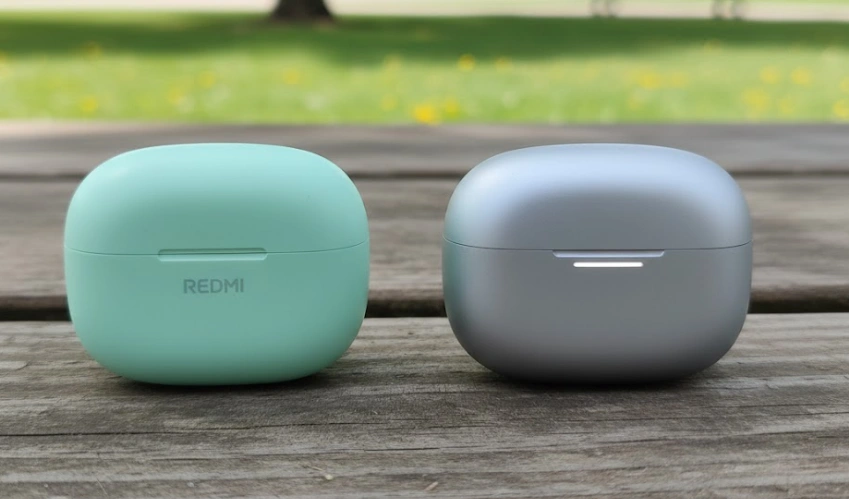
That’s not a complaint. The fit remains excellent. Both sit securely in the ear, even during runs or gym sessions, and neither creates pressure fatigue over long listening sessions. Xiaomi clearly got the ergonomics right the first time.
The one welcome tweak? Finish.
The Buds 6 Pro came in glossy variants that looked good in photos but picked up micro-scratches quickly.
The Buds 8 Pro switch to a fully matte finish. It feels more premium and holds up better over time. It’s a small change, but one that makes the new pair feel slightly more refined.
Both models keep:
- USB-C charging
- A physical pairing button
- A dynamic LED charging strip on the front (which fills like a battery bar while charging)
- IP54 dust and splash resistance
- Wear detection sensors for auto play/pause
The only real usability upgrade is volume control. On the Buds 8 Pro, you can slide your finger along the stem to adjust volume. The 6 Pro allowed it through customizable taps, but the swipe implementation feels more natural and less fiddly.
Otherwise, visually and physically, these are twins.
Connectivity
The Buds 6 Pro run on Bluetooth 5.3, while the Buds 8 Pro move to Bluetooth 5.4.
In theory, that means better efficiency and slightly improved stability. In practice, both perform reliably.
Pairing is fast, connections are stable, and latency is low enough for gaming and video playback.

Both support AAC and LHDC 5.0 (in Chinese versions), along with multipoint connectivity so you can connect to two devices simultaneously.
Software experience is identical across both models. Xiaomi’s companion app allows you to:
- Check battery levels (buds and case separately)
- Adjust ANC levels
- Customize transparency mode
- Remap touch controls
- Run ear tip fit tests
- Enable surround sound mode
There’s no meaningful difference in day-to-day connectivity performance. Both feel modern and responsive.
Microphones
This is one of the clearest improvements.
The Buds 6 Pro already handled calls well, but the Buds 8 Pro refine voice pickup noticeably. Voices sound cleaner, and background noise suppression works better in busy outdoor environments.
If you frequently take calls in noisy areas — streets, cafés, public transport — the Buds 8 Pro are a safer bet. It’s not night-and-day, but it’s a clear step forward.
Active Noise Cancellation
Both models advertise up to 55dB of active noise cancellation, and in terms of raw noise blocking power, they’re extremely similar.
Put either pair in your ears, turn on ANC, start playing music — outside noise largely disappears.
Where the Buds 8 Pro pull ahead is customization. They offer up to 20 adjustable ANC levels and an adaptive mode that adjusts based on environment and ear shape. The Buds 6 Pro don’t provide that level of fine control.
Transparency mode is also slightly more natural on the Buds 8 Pro, with less artificial coloration.
The difference isn’t dramatic, but the 8 Pro feel more sophisticated.
Sound Quality
Both earbuds use a triple-driver setup:
- Dual 6.7mm ceramic piezoelectric tweeters
- 11mm titanium-coated dynamic driver
Hardware hasn’t changed. Tuning has.
The Buds 6 Pro lean heavily toward bass out of the box. The low end is punchy and energetic, but sometimes overwhelms mids and softens vocal clarity. You can fix this with EQ adjustments in the app — and once tweaked, they sound excellent.

The Buds 8 Pro, however, arrive better balanced from the start. Bass is still present and impactful, but mids and highs are clearer and more controlled. Vocals sit more naturally in the mix, and treble feels smoother, with less sharpness.
You don’t need to tweak anything to enjoy them.
If you prefer a more balanced, refined sound without touching EQ settings, the Buds 8 Pro deliver the better out-of-the-box experience.
Battery Life
Here’s where things get unexpectedly frustrating.
With active noise cancellation enabled and volume around 50%, the Buds 6 Pro consistently deliver around 5.5 to 6 hours of playback. The Buds 8 Pro, under similar conditions, land closer to 4 to 4.5 hours.
That’s nearly an hour less.
For a new generation product, you expect at least parity, if not improvement. Instead, the Buds 8 Pro trade endurance for other refinements. It’s not disastrous, but it’s noticeable — especially if you regularly use ANC during long commutes or work sessions.
Neither model supports wireless charging. Xiaomi actually offered it in older generations, but it’s absent here. Charging is USB-C only, though both top up relatively quickly.
If battery life is high on your priority list, the older Buds 6 Pro actually win this round.
Redmi Buds 8 Pro vs Redmi Buds 6 Pro: Specs Comparison
| Category | REDMI Buds 8 Pro | REDMI Buds 6 Pro |
|---|---|---|
| Drivers | Dual DAC drivers | 6.7mm dual piezo tweeter + 11mm titanium bass driver |
| Active Noise Cancellation | Up to 55dB, 5kHz bandwidth | Up to 55dB, 4kHz ultra-wide ANC |
| Call Noise Reduction | 95dB ambient call noise reduction | 3 mics with AI noise reduction (12m/s wind resistance) |
| Bluetooth | Bluetooth 5.4 | Bluetooth 5.3 (Low Energy) |
| Audio Codecs | SBC / AAC / LHDC / MIHC / LC3 | LDAC |
| Special Features | Dolby Audio, audio sharing, dual-device switching | Google Fast Pair, 4 EQ modes, touch controls |
| App Support | Xiaomi Earphone App | Xiaomi Earbuds App |
| Water Resistance | Not specified | IP54 dust & water resistant |
| Battery Life (Buds) | Up to 8.5 hours | Up to 9.5 hours |
| Total Battery (With Case) | Up to 35 hours | Up to 36 hours |
| Fast Charging | 5 mins = 2 hrs playback | 5 mins = 2 hrs playback |
| Weight | Earbud: 5.3g | Case: 47g | Earbud: 5.2g | Case: 36.1g |
| Colours | Mist Blue, White, Black | Glacier White, Space Black, Lavender Purple |
| Price | Around $60 | Around $80 |
Final Verdict
The Redmi Buds 6 Pro are still impressive earbuds in 2026. With their extended battery life and solid performance, they’re a smart pick, especially when you can find them at a lower price.
The Redmi Buds 8 Pro don’t completely overhaul the design; instead, they enhance what was already great. They offer better sound quality right from the start, improved call performance, and more versatile noise cancellation — but you do lose some battery life in the trade-off.
If you’re already using the 6 Pro, there’s no rush to upgrade.
However, if you’re deciding between the two and want the most refined experience — and are okay with spending a little extra — the 8 Pro is the superior option.
Best Deal:
- Redmi Buds 8 Pro: View on AliExpress
- Redmi Buds 6 Pro: View on AliExpress

Nick, the Co-founder of Earbuds Arena, is a seasoned freelance tech journalist with over ten years of experience covering wearables, apps, headphones, and gadgets. When he’s not immersed in the tech world, you’ll likely find him unwinding with video games, going for a run, or enjoying a game of soccer on the field.