Some comparisons are pretty straightforward, but this one? Not so much.
The Redmi Buds 8 Pro and the Realme Buds Air 8 are priced almost identically and were launched just days apart.
On paper, they seem strikingly similar. Both offer 55dB active noise cancellation, the latest Bluetooth 5.4 connectivity, multipoint support, and audio quality that exceeds expectations for their price.
However, once you start using them side by side, the differences become not just interesting, but crucial.
If you’re on the fence about which pair to invest in, here’s the complete rundown.
Pricing
When it comes to pricing, this comparison gets even more fascinating.
The Realme Buds Air 8, at least in their current Chinese version, are going for about $50. Once the global version is launched, we can expect the price to fall somewhere between $70 and $80.
Meanwhile, the Redmi Buds 8 Pro are priced closer to $80. That price difference — which can reach around $20 depending on the market — makes the Realme option especially enticing.
Design & Build Quality
At first glance, the contrast is obvious.
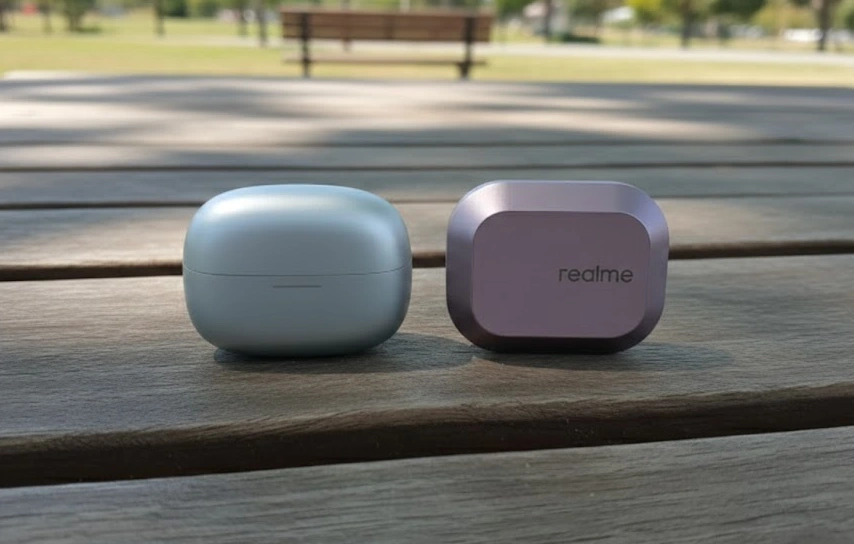
The Realme Buds Air 8 lean into a slightly flashier design. The case is a bit larger and features a textured, leather-like finish on top that gives it personality. It stands out in a way many budget earbuds don’t.
The Redmi Buds 8 Pro take the opposite approach. The matte plastic finish feels understated but premium, and the overall look is cleaner and more refined. It’s the kind of design that doesn’t scream for attention but quietly feels well made.
Both cases offer USB-C charging, a physical pairing button, and front-facing LED indicators.
Redmi, however, adds a subtle premium touch: a horizontal LED bar that fills up gradually while charging. It’s a small detail, but it feels more informative and modern compared to Realme’s basic red/green light.
In the ear, both are extremely comfortable. Whether you’re heading out for a run or spending hours at your desk, neither feels intrusive. They ship with multiple silicone tip sizes, offer in-ear detection for auto pause and resume, and stay secure during workouts.
Redmi does have one ergonomic edge: swipe gestures for volume control. Instead of tapping repeatedly, you slide your finger along the stem to adjust volume. It’s more intuitive and feels closer to what you’d expect from higher-end earbuds.
As for durability, Realme carries an IP55 rating, while Redmi sits at IP54. In real-world use, both handle sweat and light rain without issue. The difference is largely academic.
Connectivity and Software
On the technical side, both earbuds feel thoroughly modern.
Bluetooth 5.4 ensures stable connections. LHDC 5.0 support is present (depending on regional versions), and multipoint connectivity allows you to switch between devices without manually disconnecting. Latency is low enough for gaming and video streaming, and neither suffered from noticeable dropouts during testing.
The companion apps — Xiaomi’s Earbuds app for Redmi and Realme Link for Realme — offer a similar experience. You can adjust ANC strength, customize touch controls, check battery levels for each bud and the case, enable spatial audio, and tweak EQ settings or create your own.
Realme adds a small twist with AI-driven features, including translation tools in certain versions. They’re still region-limited and not fully global in scope, but it’s an interesting addition that Redmi doesn’t currently match.
In everyday use, however, both ecosystems feel mature and reliable.
Call Quality
Call performance is strong across the board.
Voices come through clearly, background noise is effectively suppressed, and both perform confidently outdoors in windy or busy environments.
If you push for differences, the Redmi Buds 8 Pro edge slightly ahead in how cleanly they isolate your voice from surrounding noise.
But the margin is slim. For most users, both will feel like top-tier performers in this category.
Active Noise Cancellation
Both earbuds are rated for up to 55dB of active noise cancellation. On paper, that sounds identical.
In practice, they behave differently.
Realme’s ANC is powerful but can introduce a bit more pressure in the ear. It’s effective, but you feel it working. Redmi’s approach is smoother.
The Buds 8 Pro allow up to 20 levels of adjustment within the app, giving you granular control over how much isolation you want.
The result feels more refined and less fatiguing over longer sessions.
If ANC quality is high on your priority list, Redmi holds a slight but noticeable lead.
Sound Quality
Both brands have clearly invested serious effort into tuning.
The Realme Buds Air 8 use an 11mm dynamic driver paired with a 6mm tweeter.
The Redmi Buds 8 Pro go further with a triple-driver configuration: an 11mm titanium-coated dynamic driver supported by dual 6.7mm piezoelectric ceramic tweeters.
The good news is that neither requires heavy EQ tweaking. Out of the box, both sound balanced and engaging.

Realme delivers punchy bass with solid presence in the mids and highs. It’s lively, energetic, and very easy to enjoy across genres. For most listeners, it will feel more than satisfying.
Redmi, however, offers slightly better midrange detail and cleaner high-frequency control. Instrument separation feels more precise, and vocals carry a touch more clarity.
The difference isn’t dramatic, but when listening closely, it’s there.
In short: Realme sounds excellent. Redmi sounds a bit more refined.
Battery Life
If there’s one area where the two clearly separate, it’s endurance.
Using both with ANC enabled, volume around 50 percent, and the AAC codec, the Redmi Buds 8 Pro deliver just over four hours — roughly four and a half in typical use.
The Realme Buds Air 8 stretch close to seven hours under the same conditions.
That’s a substantial gap.
Redmi’s shorter runtime likely comes down to its more aggressive noise cancellation processing. Whatever the reason, if you value longer listening sessions without reaching for the case, Realme has the advantage — and it’s not a small one.
Both rely on USB-C charging and neither supports wireless charging. In this price range, that’s not surprising.
Redmi Buds 8 Pro vs Realme Buds Air 8: Specs Comparison
| Category | Redmi Buds 8 Pro | Realme Buds Air 8 |
|---|---|---|
| Drivers | Dual DAC drivers | 11mm + 6mm dual-driver |
| Active Noise Cancellation | Up to 55dB, 5kHz bandwidth | Up to 55dB, up to 5000Hz range |
| Call Noise Reduction | Up to 95dB ambient noise reduction | 6-mic system |
| Bluetooth Version | Bluetooth 5.4 | Bluetooth 5.4 |
| Audio Codecs | SBC / AAC / LHDC / MIHC / LC3 | LHDC 5.0 |
| Audio Certification | Dolby Audio | Hi-Res Audio Wireless |
| Connectivity Features | Dual device connection, audio sharing, intelligent streaming | Dual device connection |
| Smart Features | Quick connect via Xiaomi Earphone App | AI real-time translation, AI call translation |
| Water & Dust Resistance | IP54 | IP55 |
| Battery Life | Up to 8.5h (buds) / 35h (with case) | Up to 58h (ANC off, with case) |
| Weight | Case: 47g; Earbud: 5.3g | Case: 47g; Earbud: 4.5g |
Final Thoughts
If you’re looking for the best active noise cancellation and a touch more sound refinement, the Redmi Buds 8 Pro are worth the extra investment.
On the flip side, if you consider the overall picture—battery life, great audio, solid connectivity, and better value—the Realme Buds Air 8 are incredibly appealing.
This isn’t just a straightforward case of one product outshining the other; it’s really about what you prioritize.
For many buyers, especially those who care about battery life and getting the most for their money, Realme is quietly taking the lead this year.
This makes for one of the most thrilling true wireless competitions in its category.
Best Deal:
- Redmi Buds 8 Pro: View on AliExpress
- Realme Buds Air 8: View on AliExpress
You might like:
- Xiaomi Redmi Buds 8 Pro vs Buds 6 Pro: What’s Really New?
- Realme Buds Air 8 vs Buds Air 7: Should You Upgrade?
- Realme Buds Air 8 vs Buds Air 7 Pro: Which Is Better Now?
- Redmi Buds 8 Lite vs Buds 6 Pro: Which One Is Better?
- Redmi Buds 8 Lite vs Redmi Buds 6 Lite: What’s Really New?

Nick, the Co-founder of Earbuds Arena, is a seasoned freelance tech journalist with over ten years of experience covering wearables, apps, headphones, and gadgets. When he’s not immersed in the tech world, you’ll likely find him unwinding with video games, going for a run, or enjoying a game of soccer on the field.