It’s quite fascinating to compare the Nothing Headphone (a) with the CMF Headphone Pro.
On the surface, it appears to be a straightforward battle between a $199 headphone and its $99 sibling.
But after spending some time with both, you quickly realize that this isn’t just a competition — it’s a clash of philosophies.
They come from the same parent company and share some DNA, yet they represent two distinct ideas about what a wireless headphone ought to be.
This intriguing tension makes it one of the most interesting comparisons in the sub-$200 range today.
Also see: Nothing Headphone (a) vs Headphone (1): What’s the Difference?
Look & Feel
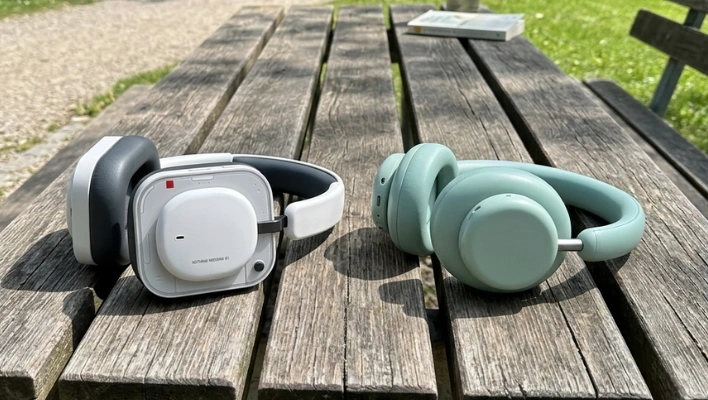
Nothing’s approach here is refreshingly clear—almost to the point of being transparent. The Headphone (a) embraces the brand’s iconic industrial design, featuring semi-transparent ear cups that give a glimpse of the internal components, making it pop in a sea of competitors. It feels intentional, almost like it’s meant to be admired as much as it is to be listened to.
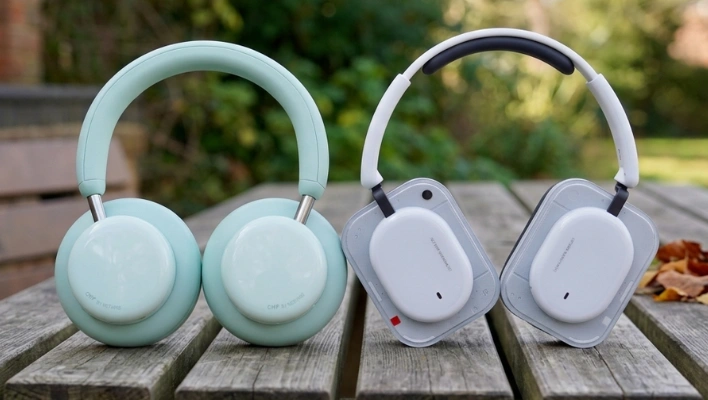
On the flip side, CMF takes a more subtle route. At first glance, the Headphone Pro seems pretty standard, sporting a matte finish and low-key color choices. But if you take a moment to really look at it, you’ll see that CMF isn’t focused on making a splash right away—it’s all about winning you over gradually, with its versatility and practicality.
This difference in mindset really sets the tone for the whole comparison.
Sound Quality
Both headphones come equipped with 40mm dynamic drivers, but that’s where the similarities end.
The Nothing Headphone (a) boasts titanium-coated diaphragms, which help maintain rigidity under pressure and minimize distortion at higher volumes.
On the other hand, the CMF Headphone Pro opts for nickel-plated diaphragms paired with copper voice coils in a dual-chamber setup.
Both models are Hi-Res certified and support LDAC at up to 990 kbps, delivering impressive 24-bit audio quality over Bluetooth, regardless of their price tags.
In terms of sound profile, the Nothing Headphone (a) is tuned for bass, but it’s not the typical low-end chase you find in budget headphones. The sub-bass is well-controlled, and the soundstage is notably expansive—one reviewer even likened it to a “big expansive highway” compared to the Headphone 1. There’s a real sense of space between instruments, making it feel lively without becoming overwhelming.
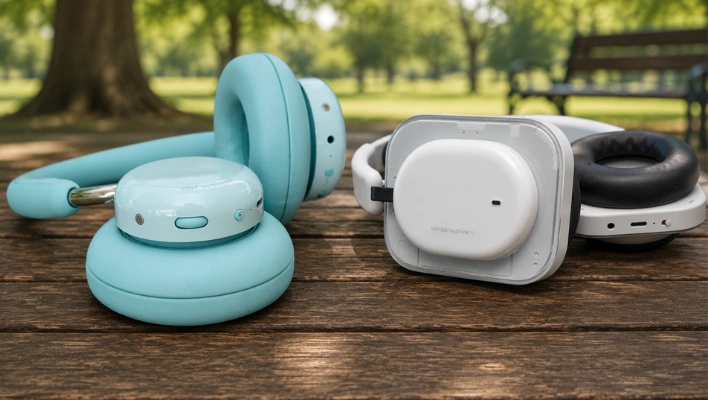
The CMF Headphone Pro, however, tells a different story right out of the box. The bass can come off as a bit bloated, and some tracks might reveal a touch of sibilance in the highs. While it’s not a deal-breaker, it doesn’t make the best first impression. But once you engage LDAC and tweak the EQ a bit, the CMF evolves into something truly impressive for just $99.
In the hierarchy of Nothing’s lineup, it goes: CMF is good, the Headphone (a) is better, and the Headphone 1 is the best—but the difference between good and better is much smaller than you’d expect for a $100 price gap.
Noise Cancellation
Both headphones boast an impressive noise reduction of up to 40 dB, but the technology behind that figure is quite different.
The Nothing Headphone (a) features a clever hybrid system that combines feed-forward and feedback microphones, utilizing five mics and AI processing that adapts in real time to your fit and surroundings. You can choose from three ANC presets—low, mid, and high—along with a transparency mode. This adaptive feature is genuinely handy if your day takes you from a bustling subway to an open office and then to a quiet room, as each of these environments has its own unique sound profile.
On the other hand, the CMF Headphone Pro’s ANC has shown in real-world tests to block about 81% of outside noise, with around 30 dB of attenuation in the sub-bass and bass frequencies, sometimes even surpassing the company’s own 40 dB claim at higher frequencies. For a headphone priced at $99, that’s quite impressive.
If you’re after AI-enhanced ANC that adjusts to your surroundings, the Nothing Headphone (a) is the more advanced choice. But if you simply need reliable noise cancellation, the CMF will do the job just fine.
CMF’s Wildcard
Here’s where CMF does something Nothing doesn’t, and it’s more interesting than it first appears.
The CMF Headphone Pro has swappable ear cushions — you can pull them off and replace them with different colors, different materials, at around $25 per set. That’s a meaningful customization, but what makes it genuinely clever is the acoustic dimension: different cushion materials affect passive isolation, how bass behaves, and how sound enters your ear. You’re not just picking a color; you’re actually influencing how the headphone sounds.
Then there’s the energy slider. It’s a physical slider on the ear cup that adjusts bass and treble emphasis in real time. No app, no menus, no digging through settings — just move the slider and the sound changes instantly.
CMF also includes Audio Dos personalized sound profiling in its app — a short hearing test that generates a custom EQ curve based on your actual hearing response. That’s a feature that typically lives in much more expensive headphones.
Connectivity is equally well-equipped: Bluetooth 5.4, multi-point pairing, Google Fast Pair, Swift Pair for Windows, full iOS support, and a low-latency game mode under 120 milliseconds.
What the Extra $100 Buys You on the Nothing Side
The Nothing Headphone (a) answers with its own set of advantages. The right ear cup carries a volume roller, a track skip rocker, a physical power switch, a customizable shortcut button, a Bluetooth pairing button, USB-C, and a 3.5mm headphone jack.
That’s a comprehensive physical control layout that reduces how much you need to reach for your phone. The customizable shortcut button can also trigger your phone’s camera shutter remotely — a genuinely thoughtful addition if you shoot content or take a lot of hands-free photos.
There’s also an IP52 rating — dust protected and resistant to light rain — which the CMF doesn’t have at all. If you use headphones at the gym or you’re caught outside in unpredictable weather, that matters.
The Nothing X app adds an eight-channel EQ, a simpler drag-block EQ for casual listeners, community-shared presets you can download, plus concert and cinema modes. It’s a mature, well-developed software ecosystem.
Nothing Headphone (a) vs CMF Headphone Pro: Specs Comparison
| Specification | Nothing Headphone (a) | CMF Headphone Pro |
|---|---|---|
| Price | $199 | $99 |
| Design | Transparent, premium build | Minimal matte, modular design |
| Driver | 40mm titanium-coated dynamic | 40mm nickel-plated dynamic |
| Audio Codecs | SBC, AAC, LDAC | SBC, AAC, LDAC |
| Noise Cancellation | Adaptive Hybrid ANC (~40dB) | Hybrid ANC (~40dB) |
| Battery (ANC Off) | Up to 135 hours | Up to 100 hours |
| Battery (ANC On) | Up to 75 hours | Up to 50 hours |
| Connectivity | Bluetooth 5.4, multipoint | Bluetooth 5.4, multipoint |
| Ports | USB-C, 3.5mm jack | USB-C, 3.5mm jack |
| Weight | 310g | ~283g |
| Water Resistance | IP52 | IPX2 |
| Special Features | Physical controls, app EQ, AI ANC | Energy slider, modular cushions, custom EQ |
Final Verdict
Buy the CMF Headphone Pro if you’re working within a budget and don’t want to make real compromises on core features. LDAC support, ANC that works, 40-plus hours of real-world battery, modular cushions, the energy slider, and personalized sound profiling — at $99, and especially if you catch it on sale for around $80, there’s almost no weakness in this package. It’s one of the strongest dollar-for-dollar propositions in wireless audio right now.
Buy the Nothing Headphone (a) if battery life is a genuine priority, or if you’re deep in the Nothing and Android ecosystem and want the most integrated experience. The 75-hour ANC battery is nearly impossible to compete with anywhere near this price. The physical controls are more comprehensive, the sound quality is a clear step above the CMF without approaching flagship money, and the IP52 rating matters if you lead an active life.
Best Deal:
- Nothing Headphone (a): View on Amazon
- CMF Headphone Pro: View on Amazon

Nick, the Co-founder of Earbuds Arena, is a seasoned freelance tech journalist with over ten years of experience covering wearables, apps, headphones, and gadgets. When he’s not immersed in the tech world, you’ll likely find him unwinding with video games, going for a run, or enjoying a game of soccer on the field.